what is it like to have a pet snake
There are approximately ii,500 different species of snakes. Several species are commonly kept as pets including king snakes, rat snakes, garter snakes, corn snakes, various pythons (peculiarly ball pythons), and various boa constrictors (especially the mutual boa constrictor). The needs of ane species may differ from those of another, so be sure to hash out specific questions with a knowledgeable herpetologist (someone who studies reptiles and amphibians) or a veterinarian familiar with reptiles. The ball python volition be used for this discussion, as information technology is one of the most commonly kept pet snakes. Almost of the information concerning the ball python is applicable to other terrestrial snake species.
Most snakes sold as pets are like shooting fish in a barrel to handle and are usually not aggressive. Although certain species of snakes unremarkably kept past serious reptile collectors have a naturally aggressive nature, these species tend non to testify up often in the general pet trade, so they are not typically available in pet stores. 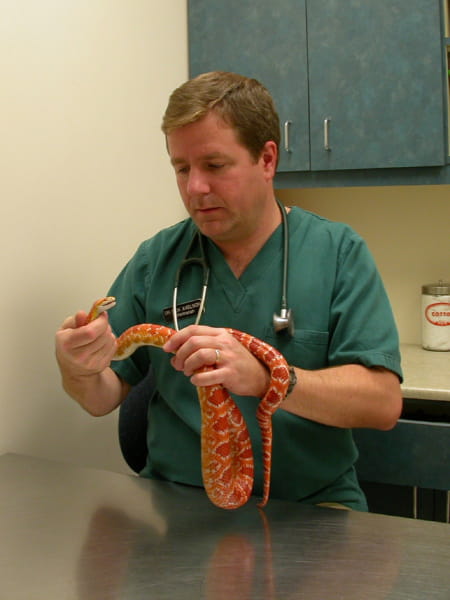
Some snakes, especially the brawl python, may not eat for weeks to months afterward the stress of going to a new abode and new environment. Lack of appetite can be a normal reaction to stress, but if prolonged, it may be a sign of a more serious problem that requires prompt veterinary attention.
"Some snakes, especially the ball python, may not eat for weeks to months after the stress of going to a new home and new environment."
Ideally, but captive-bred animals should be sold every bit pets. Wild-caught snakes are less tolerant of stress, more likely to refuse food, and often harbor college numbers of internal and external parasites.
Male person and female person snakes look identical for most species. Your veterinarian can carefully probe the snake'southward vent (opening to the cloaca) with a special instrument to determine the sex of your pet. Serpent sexing should just exist performed by an individual trained in this procedure, equally the snake may be injured by an inexperienced person probing.
Hatchling ball pythons are about a pes long and grow to about 3 feet by 3 years of age. At maturity (reached in 3-5 years), adults reach 5-6 feet in length. Depending upon their intendance, brawl pythons can live 10-20 years.
How exercise snakes differ anatomically from other pets?
- Snake's skin is covered in leathery scales. Opposite to popular misconception, the skin is smoothen, frequently shiny, and dry out to the bear on. Snakes are not slimy. Since snakes are ectotherms (their trunk temperature is determined by their environmental temperature), the temperature of their skin reflects the surrounding temperature, and if the surrounding temperature is cold, their skin feels moisture.
- Snakes have coverings over their eyelids called spectacles, instead of eyelids, and their optics are open all the time.
- Snakes shed their pare every few weeks equally they grow. A good for you ophidian in a healthy environment sheds its old pare in one piece. If it does not, and pieces of old skin are retained on the trunk later a shed, your veterinarian should bank check the snake to ensure there is no underlying infection or problem with inadequate humidity.
- Snakes, like all reptiles, are ectotherms, so they are dependent on external or environmental sources of heat to maintain their own body oestrus.
- Most snakes take only one functional, simple lung (usually the right lung; the other lung is smaller or completely absent). Boas and pythons are the exception to this, having two lungs. Snakes do not take a diaphragm (muscle that separates the chest and the abdomen in mammals); they move the muscles of the ribs and body wall to pump air in and out of the lungs. The lung can occupy much of the ophidian's body between the middle and the hind end.
- Snakes eat their food whole. At that place are no vegetarian snakes; all species are carnivores. Their diet depends on the species of ophidian. Some volition specifically eat warm-blooded casualty (e.g., rodents, rabbits, birds), while others swallow insects, amphibians (frogs and toads), eggs, other reptiles, fish, earthworms, or slugs.
- Snakes take a cloaca, a bedchamber at the hind end of the snake into which the urinary, digestive, and reproductive tracts all empty. The cloaca empties to the outside through the vent plant on the snake's underside, at the base of the tail. They defecate, urinate, and reproduce through the cloaca. By inserting a special probe advisedly in the cloacal surface area, a knowledgeable veterinarian can tell the sex of the snake.
- Snakes have no limbs, merely information technology has been suggested that the ii spurs that are present on either side of the vent of boas and pythons represent vestigial limbs.
- Snakes take numerous pairs of ribs running the length of their body.
- Snakes accept three-chambered hearts, whereas mammals and birds accept iv-chambered hearts.
- Snakes have no diaphragm; this prevents them from being able to cough or clear their airways of mucus. As a result, snakes with simple respiratory infections may develop pneumonia.
- Males take two reproductive organs, called hemipenes, which are found just within the vent.
How do I select a snake?
Virtually owners buy snakes locally from pet stores, although mail ordering from reptile breeders is also common. If yous buy a pet through the mail service, make certain y'all know what y'all are getting! It is better to see the animal before yous purchase it. Ask about a guarantee if the pet does not plough out to be what you want or is non healthy Snakes as well are available for adoption from shelters.
Young, captive-raised animals make the best pets. Older, imported, wild-caught animals are harder to tame, may harbor more internal and external parasites, and often suffer illness from the stress in captivity.
"Shedding is very stressful to snakes and it would be best to purchase a snake that is not about to shed."
Start out right with a good for you pet. Avoid snakes that appear skinny or bony, have loose peel or sunken optics, and seem inactive or lethargic. A healthy snake is normally bright, active, and alert. The eyes should be articulate. Cloudy eyes may betoken that the snake is about to shed. While not a sign of illness, shedding is very stressful to snakes, and they oftentimes practise not eat when they are shedding. Information technology is all-time not to buy a snake that is about to shed. Check around the snakes' eyes and under its scales for mites, which look like tiny black dots that movement. Make certain no lumps or bumps are present and in that location are no sores or discolorations on the skin. But running your easily slowly downwardly the snake'due south body will permit you to detect whatsoever swellings. The vent should be clean and free of wetness or stool stuck to it. If possible, gently open the mouth. There should be a pocket-size amount of articulate saliva present and a pink tongue. Large amounts of cloudy-looking or cottage cheese-similar mucus, or red, bloody, or hobbling gums may exist a sign of oral cavity infection.
My serpent looks healthy. Does he really need to see a veterinarian?
Within 48 hours of your purchase, your snake should exist examined by a qualified reptile veterinarian. The veterinarian visit typically includes determining the animate being'due south weight, equally well equally checking for abnormalities such equally lumps and bumps or signs of external parasites. The reptile is examined for signs of dehydration and malnutrition. The mouth is examined for signs of infection (called stomatitis). A microscopic analysis of the feces is done to check for internal parasites. Many veterinarians consider all snakes (even those bred in captivity) to accept intestinal parasites and recommend routine antiparasitic treatment. Vaccines are non required for snakes. Your veterinarian may recommend blood tests, cultures, or X-rays to check for other diseases if the serpent appears unhealthy.
Like all pets, snakes should be examined at to the lowest degree annually, and a fecal examination, looking for parasites, should be role of every test.
Source: https://vcahospitals.com/know-your-pet/snakes-owning
0 Response to "what is it like to have a pet snake"
ارسال یک نظر