it is illegal to water ski unless the skier is wearing what
Boating Rules and Regulations
Prohibited Operations:
- Operating a vessel or personal watercraft under the age of 12. Must be 14 years old and take a vessel license to operate a vessel or personal watercraft alone.
- Operating a vessel in such a mode and at a charge per unit of speed as will create a hazardous launder or wake when approaching or passing some other vessel or when entering or leaving a harbor or marina area.
- No person, except in jump buoys and similar objects used normally in competitive and recreational skiing, shall operate or manipulate any vessel, tow rope, or other device by which the direction or location of water skis, aquaplane, or like device may be affected or controlled in such a way as to crusade the h2o skis, aquaplane, or like device or any person thereon to collide with or strike any object or person.
- Operating a vessel towing a person or persons on water skis, or an aquaplane or similar device unless there is in the vessel a person, in addition to the operator who is at to the lowest degree 12 years of age and is observing and is capable of communicating to the operator the progress of the person being towed or unless the vessel is equipped with a broad-angle mirror with a viewing surface of at least 500 sq. centimeters (78 square inches) and a field of vision of at least a 170 degrees.
- Operating a vessel to a higher place plane speed when persons or equipment are positioned in a way that would obstruct the operator's view or impair the condom operation of the vessel. (Sailboats are exempt from this section)
- Operating a vessel in violation of any established speed zone.
- Operating a vessel after Apr 28, 1999, which violates federal laws regulating the horsepower of the engine of the vessel.
- The exhaust of every internal combustion engine used on any vessel shall be effectively muffled by equipment so constructed and used equally to muffle the noise of the exhaust in a reasonable mode. It is unlawful for whatever person to operate or give permission to operate whatsoever vessel powered by an engine or outboard motor in such a manner equally to exceed a racket level of 86 decibels measured at a minimum altitude of xv.two meters (50 anxiety) from the vessel. The employ of cutouts is prohibited, except for vessels competing in a regatta or official gunkhole race, and for such vessels while on trial runs.
- Sponsoring a regatta, race, marine parade, tournament, trial runs, or exhibition without providing adequate protection from marine traffic, interference and hazards and obtaining a permit at least 15 days prior to the result.
- No person shall operate or give permission to operate any vessel on the waters of this land towing a person or persons on h2o skis, surfboard, spinners, or other similar devices unless such person or persons being towed are wearing a Type I, II, III, or Blazon V U. S. Coast Guard approved personal flotation device (PFD).
- Operating or giving permission for the operation of any vessel unless the vessel is currently registered and numbered in accordance with laws and regulations.
- No person shall operate whatever vessel on the waters of this land within 244 meters (800 feet) beneath a hydro-electric dam and/or navigational lock and dam unless each person aboard, including the operator, is wearing a U. S. Declension Guard approved personal flotation device Type I, Two, 3, or V. Such personal flotation device will be worn and securely fastened in accordance with manufacturer'due south instructions and recommendations for such personal flotation device.
- No vessel shall be loaded with passengers or cargo across its prophylactic conveying capacity, taking into consideration atmospheric condition and existing operating weather condition.
- No person shall moor to, except in emergencies or interfere with, destroy, submerge, climb upon, damage, motion, or cause to be removed from its mooring, whatsoever regulatory signs, markers, or aids to navigation.
- No person shall operate or give permission for the functioning of a vessel which is non equipped with prophylactic equipment required by law.
Boating Under the Influence
No person shall drive or be in actual physical control of a vessel or manipulate whatever water skis, aquaplane, or any other marine transportation device while:
- there is 0.08% or more by weight of alcohol in the claret.
- nether the influence of alcohol.
- under the influence of a controlled substance.
- under the combined influence of alcohol and a controlled substance.
- under the influence of any substance which impairs the mental or physical faculties of the person.
Refusal to submit to a field breath test or other canonical testing shall outcome in the same punishment as provided for operators of motor vehicles on the state highways (automated intermission of vessel license).
H2o Traffic "Rules of the Route" in the State of Alabama
- Vessels passing caput-on shall go on to the correct.
- Vessels overtaking another vessel may practice and so on either side but must grant the correct-of-way to the vessel being overtaken.
- When vessels are passing at right angles, the vessel on the left will yield the correct-of-way to vessel on the right.
- Motorboats shall yield the right-of-fashion to non-motor powered boats except every bit follows:
- When existence overtaken by non-powered vessels.
- For deep draft vessels that accept to remain in narrow channels.
- When a vessel is towing another vessel.
- Motorboats must maintain a direct course when passing sailboats.
- Any vessel approaching a landing dock or pier shall yield the right-of-manner to whatsoever parting vessel.
- Any vessel departing shoreline or tributary shall yield the right-of-way to through traffic and vessels approaching shoreline or tributary.
- Vessels will not abruptly modify course without outset determining that it can be safely done without take a chance of standoff with another vessel.
- If an operator fails to fully understand the grade of an approaching vessel, he must slow down immediately to a speed barely sufficient for steerage-fashion until the other vessel has passed.
- Vessels yielding right-of-way shall reduce speed, terminate, reverse, or alter course to avert a standoff. Vessel with right-of-fashion shall concord course and speed. If there is danger of collision, all vessels will slow down, stop, or reverse until danger is averted.
- Vessels will result warning signals in fog or thick atmospheric condition.
- No mechanically propelled vessel shall exist operated in a round course around any other vessel or any person swimming.
- In a narrow aqueduct, vessels will go on to the right of mid-channel.
- Vessels approaching or passing some other vessel shall exist operated in such manner and at such rate of speed as will not create a hazardous launder or wake.
- No vessel shall obstruct or interfere with take-off, landing, or taxiing of aircraft.
- All vessels shall exist operated at reasonable speeds for given situations and must exist under the complete control of the operator at all times.
- No person shall, under whatever circumstances, operate a vessel in excess of an established speed zone.
- No vessel or person shall obstruct or block the navigation channel, entrance to the aqueduct, mooring skid, landing dock, launching ramp, pier or tributary.
- Vessels shall proceed at to the lowest degree 100 anxiety clearance of displayed diver'southward flag.
- Operator shall maintain a proper spotter.
Whenever the manager of the Marine Patrol Division shall make up one's mind that in the interest of public safety it is necessary to restrict the speed of boats or boating activities on, or prohibit the entrance into, certain areas of the waters of this Country or otherwise regulate or prohibit the utilise of boats or h2o skis (including all devices similar to water skis) in such areas, he shall designate such areas by appropriate signs or buoys.
Information technology is unlawful to operate a vessel in a reckless manner upon the waters of this land. A person is guilty of reckless operation when he operates any vessel or manipulates any waterskis or whatever other marine transportation device upon the waters of this state in a willful or wanton disregard for the rubber of persons or property at a speed or in a manner to endanger or likely to endanger life, limb, or property or injury of any person.
It shall be unlawful to operate a vessel in a careless mode upon the waters of this country. Careless operation is the endangerment of life, limb, or holding through negligence, carelessness, or inattention of the operator.
Examples of careless performance include but is non limited to the post-obit:
- Sitting in any position that is above the gunwale or cap of a vessel while moving above idle speed.
- Riding on the bow of a vessel not equipped with handrails.
- Riding on a vessel with lower extremities hanging over the gunwale or cap of the vessel.
- Creating hazardous wake in a congested area.
Regulations:
The Boating Safety Human action of 1959, the Roberson/Archer Act of 1994, and the Canoeing Rubber Enhancement Act of 2001 are designed to promote the full apply and enjoyment of Alabama's waterways, provide for the registration of watercraft, and insure the safety of persons and belongings in connection with the apply of the waters of the Country.
Vehicular Homicide:
Whoever shall unlawfully and unintentionally crusade the death of another person while engaged in the violation of any country or municipal ordinance applying to the functioning or use of a vehicle or vessel or to the regulation of traffic or canoeing shall be guilty of homicide when the violation is the gauge cause of death.
Accidents:
Any operator of a boat involved in an blow causing loss of life, injury, or impairment in excess of $50.00, must, within ten days, submit an accident report to the Marine Patrol Segmentation, Department of Conservation and Natural Resources on forms provided by Marine Patrol Officers, Marine Patrol Division or County Sheriff's Offices.
Navigation Lights:
Gunkhole operators must brand certain that their boats are equipped with the proper navigation lights and use the lights during these conditions:
-
When away from the dock between dusk and sunrise.
-
During periods of restricted visibility such every bit fog or heavy pelting.
No other lights that may be mistaken for required navigation lights may be exhibited. Note: blue flashing lights are restricted to utilize by law enforcement boats only.
The required navigation lights differ depending on the type and size of your gunkhole. The common lighting configurations for recreational boats are shown below. U. S. Declension Guard's "Navigation Rules" has other configurations and requirements for larger boats.
Power-Driven Boats Less Than 12 Meters Long When Underway:
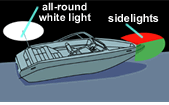 If less than 12 meters (39.iv ft.) long, these boats must exhibit the lights equally shown in figure one. Remember, power-driven boats include sailboats operating under ability. The required lights are:
-
Ruby and green sidelights (combination or separate lights) visible from a altitude of at least one mile
-
An all-circular white calorie-free or both a masthead light and a sternlight. These lights must be visible from a distance of at to the lowest degree ii miles. The all-round white low-cal (or the masthead light) must be at least one meter (3.three ft.) higher than the sidelights.
-
An culling to the sidelights and sternlight is a combination of red, green and white light which must be exhibited virtually the top of the mast.
Unpowered Boats When Underway
Unpowered boats are sailboats or those that are paddled, poled and rowed:
-
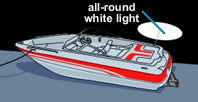
If less than twenty meters (65.6 ft.) long, these boats must exhibit the lights as shown in figure two:
-
Reddish and greenish sidelights visible from a distance of at least ii miles (or if less than 12 meters (39.4 ft.) long, at to the lowest degree i mile)
-
A sternlight visible from a distance of at least 2 miles.
-
-
If less than 7 meters (23.0 ft.) long, these boats should:
-
If practical, exhibit the same lights every bit required for unpowered boats less than 20 meters (65.6 ft.) in length
-
If not practical, they must have on hand at least one lantern or flashlight shining a white low-cal equally shown in figure three.
-
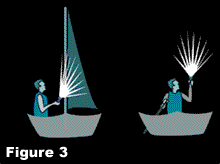 Boat operators should never get out shore without a flashlight. Even if you plan to return before night, unforeseen developments like engine problem might delay your return past nightfall.
All Boats When Not Underway: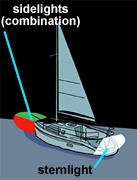
All boats are required to display a white lite visible from all directions whenever they are moored or anchored away from dock between dusk and sunrise.
Practice yous ride a personal watercraft? (Jet Ski, Waverunner, Body of water-Doo, Etc.)
If so, listed are laws and regulations you should know:
-
All operators, passengers or persons existence towed must wear a U.S. Declension Guard approved life preserver. (Violation results in a minimum $100 fine plus court costs.)
-
Unless your personal watercraft has the self-circling feature, you must have a "kill switch" attached to the operator. (Violation results in a minimum $100 fine plus court costs.)
-
No person under the historic period of 12 may operate a personal watercraft. Must be 14 years old and have a vessel license to operate a vessel or personal watercraft lonely. Operators 12 or 13 years old, afterwards obtaining the vessel operator'due south license, tin only operate if there is someone 21 years old or older on board, who also has a vessel operator's license in possession, and is seated in a position to have immediate control of the vessel if necessary. (Violation results in a minimum $100 fine plus courtroom costs.)
-
No person shall maneuver a personal watercraft in a manner which endangers life, limb or property. (Violation results in a minimum fine of $150 plus courtroom costs.)
- Examples:
-
Weaving through congested vessel traffic at high speed.
-
Following closely behind within the wake of a vessel towing a person or persons on h2o skis, surfboard or other water sport device.
-
Jumping the wake of another vessel traveling in the same direction in close proximity to the vessel.
-
Cutting between a gunkhole and the person or persons beingness towed by that boat.
-
Crossing at right angles in close proximity to the stern of some other vessel, or when visibility around the other vessel is obstructed.
-
Steering a personal watercraft toward any object or person in the h2o and turning sharply at close range so as to spray the object or person.
-
- Examples:
-
All personal watercraft used for towing any person shall exist equipped with rearview mirrors. The mirrors must comprise a minimum viewing area size of x (10) square inches. Each mirror must have a minimum viewing area top of two.v inches and a minimum viewing expanse width of four inches. The mirrors must exist fastened or mounted on both the right and left sides of the personal watercraft and so as to provide the maximum rearward observation by the operator. Mirrors shall not be mounted on the steering mechanism of the personal watercraft. The minimum combined viewing area of both mirrors shall be 20 (20) square inches. NOTE: An observer is non accepted in lieu of mirrors. (Violation results in a minimum $100 fine plus court costs.)
-
All personal watercraft operators must comply with the waterway "Rules of the Road". (Violation results in a minimum $50 fine plus courtroom costs.)
This is non a complete listing of all laws and regulations. Additional data can be obtained by contacting the Alabama Marine Patrol Division, Didactics/Operator Certification Section, 301 S. Ripley Street, Montgomery, AL 36104; (334) 517-2950.
Personal Flotation Devices (PFDs)
All boats must exist equipped with U. S. Declension Guard-canonical life jackets called personal flotation devices or PFDs. The quantity and type depend on the length of your boat and the number of people onboard and/or beingness towed. Each PFD must exist in good status, the proper size for the intended wearer and, very importantly, must be readily accessible! Readily accessible means you must be able to put the PFD on in a reasonable amount of time in an emergency (gunkhole sinking, on burn down, etc.). PFDs should not be stowed in plastic bags, in locked or closed compartments, or take other gear stowed on top of them.
Boat operators should inquire everyone on their boat to wear a PFD whenever on the water. PFDs can salve lives, only only if they are worn!
PFD Descriptions:
TYPE I: Offshore Life Jackets 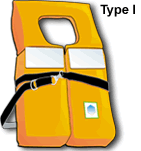
These vests are geared for rough or remote waters where rescue may take a while. They are first-class for flotation and will turn most unconscious persons face up in the water.
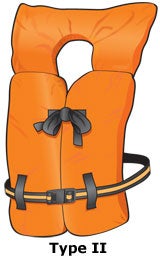 Blazon 2: Near-Shore Vests
These vests are adept for at-home waters and fast rescues. Type Two vests may lack the capacity to turn unconscious wearers face up.
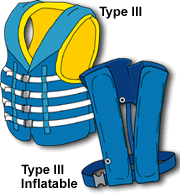
Blazon III: Flotation Aids
- These vests or full-sleeved jackets are good for calm waters and fast rescues. They are not for rough waters since they will not turn a person face up. Some Blazon Iii PFDs are designed to inflate when yous enter the water.
-
Type 4: Throwable Devices
- These cushions or band buoys are designed to exist thrown to someone in trouble. They are non for long hours in rough waters, non-swimmers or the unconscious.

 Type V: Special-Use Devices
These windsurfing vests, deck suits, hybrid PFDs, and others are designed for specific activities, such equally kayaking or water skiing. Some Blazon V PFDs are designed to inflate when you enter the water. Inflatable Blazon 5 PFDs must be worn when underway to be acceptable.
PFD Requirements:
- All boats must carry one Type I, Ii, 3, or V U. Due south. Coast Guard-approved PFD for each person onboard or being towed. If a Type V PFD is used, it must be approved for the activeness at mitt.
- All PFDs must be in skilful and serviceable condition and be readily accessible. The PFDs must be of the proper size for the intended wearer. Sizing for PFDs is based on body weight and chest size.
- In add-on to the to a higher place requirements, boats 16 ft. in length or longer must accept one Blazon IV U. S. Declension Guard-approved PFD onboard and readily accessible.
- Children nether viii years of historic period must habiliment a properly secured U. Southward. Coast Guard-approved PFD at all times while onboard whatever boat, except when in an enclosed cabin.
- Each person onboard a personal watercraft must wear a properly secured U. S. Declension Guard-approved PFD.
- Each person beingness towed behind a boat or PWC must wear a properly secured U. Southward. Declension Guard-approved PFD.
- Each person onboard a boat within 800 anxiety below a hydroelectric dam and/or navigational lock and dam must article of clothing a Type I, Two, 3, or V U. S. Coast Baby-sit-approved PFD.
The text and graphics on this page are used by permission. Copyright © 2007 Boat Ed .
Source: https://www.alea.gov/dps/marine-patrol/boating-rules-and-regulations
0 Response to "it is illegal to water ski unless the skier is wearing what"
ارسال یک نظر